Early History Of Freemasonry In Alberta
Fort Edmonton Masonic Museum
The history of Freemasonry in Edmonton dates from the early 1880s when, in February of 1882, Saskatchewan Lodge No. 17 was instituted under the jurisdiction of the Grand Lodge of Manitoba. The new Lodge was made up of 13 chartered members who lived in the area immediately surrounding Fort Edmonton.
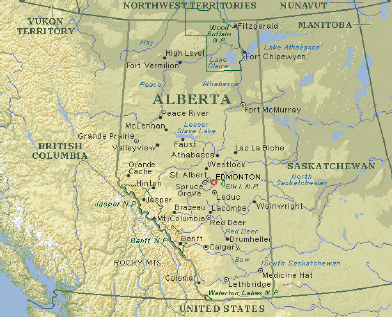
Map of Alberta, Canada
This was the first Freemasons’ Lodge to be located within the boundaries of what we know as Alberta. At the time, the area currently comprising the Provinces of Saskatchewan and Alberta was known as the North West Territories.
Transportation to Edmonton in the early 1880’s was primarily by way of the North Saskatchewan River. Approximately 300 people lived in the area. During the first few years of existence the Lodge was able to increase membership to 30. However, the small population and frontier type living conditions made it difficult for the Lodge to operate. As a result, the members of Saskatchewan No. 17 found it necessary to surrender their charter in 1888.
In 1891 the railway arrived in Strathcona (now part of Edmonton). This transportation link to the outside world brought with it a great influx of commerce, and population and once again the Masons living in the area met to consider the formation of a Lodge. In July of 1892, a petition was prepared for presentation to the Grand Lodge of Manitoba for the formation of a new Lodge in Edmonton. The revival of the name “Saskatchewan” was discussed at the organizing meeting. However, the name “Edmonton” was eventually selected. The Grand Lodge of Manitoba granted a dispensation on October 20, 1892, and in June of 1893 issued a charter to Edmonton Lodge No. 53 G.R.M. Of the sixteen charter members, eleven had been members of Saskatchewan Lodge No. 17, including WBro C.W. Sutter who served as the first Worshipful Master of the new Lodge. The Lodge chose to work in the Ancient York Rite as had Saskatchewan Lodge No. 17 before it.
The population of the region continued to expand with the result that Acacia Lodge No. 66 G.R.M. was chartered in 1897 in Strathcona. In 1900 Jasper Lodge No. 78 was chartered in Edmonton and was the first Canadian Rite Lodge in the region.
Dr. A.E. Braithwaite joined Edmonton Lodge No. 53 G.R.M. in 1893 and was installed as its Master in 1898. He had come west with the North West Mounted Police and played an active role in their efforts to put down the Riel rebellion. He became Grand Master of the Grand Lodge of Manitoba in 1903, the only member residing outside the Province of Manitoba to be elected to that position.
The Grand Lodge of Manitoba held meetings in Banff in 1894 and Calgary in 1902; and its Annual Communication in Edmonton in 1904.
The Provinces of Alberta and Saskatchewan were formed in 1905. That same year, the Grand Lodge of Alberta was established. There were eighteen Masonic Lodges operating within the new Province of Alberta with a total membership of about 1,170. They covered the south from Medicine Hat in the east to Pincher Creek in the west; and from Fort MacLeod through Calgary and Banff to Edmonton and Fort Saskatchewan in the north. These Lodges fell under the jurisdiction of the new Grand Lodge and were renumbered chronologically in the order of the date of their original charters from the Grand Lodge of Manitoba. Edmonton Lodge No. 53 became No. 7, Acacia became No. 11, and Jasper Lodge became No. 14 on the register of the Grand Lodge of Alberta.
In 1903 Edmonton Lodge constructed a Masonic Hall located on the west side of 102 Street, south of Jasper Avenue, opposite Johnstons Walker’s store. The ground floor was rented out initially to Alberta College, then to Customs and Excise, and later on for many years to Shaw Cigar Factory. (At one time there were five cigar factories in Edmonton.) This Hall served Edmonton Masons until 1930 when the Masonic Temple on 100 Avenue between 103 and 104 Streets was opened.
The Grand Lodge of Manitoba held its annual Communication in the 102 Street Masonic Hall on June 8, 1904, with Dr. Braithwaite presiding as Grand Master. Many of the delegates and Grand Lodge Officers attending this Communication arrived via the first Pullman sleeping car to the west. An exact replica of the 102 Street Masonic Hall was built at Fort Edmonton Park during the early 1980’s through the efforts of the Ionic Club of Edmonton, which is comprised of the members of Edmonton Lodge No. 7 and Eastgate Lodge No. 192. Members of the Solid Symbol Society (Highlands Lodge No. 168) provided additional funding to assist with the construction as did the Provincial Government and the Fort Edmonton Foundation. Artifacts and Masonic paraphernalia have been donated or placed on permanent loan by many area Lodges, the Grand Lodge of Alberta and individual Masons or their families.
In 1986 the reconstructed Masonic Hall was opened as a “living museum.” Many artifacts are on permanent display in the form of an operating Lodge room. Dr. Braithwaite’s Grand Master’s regalia forms part of the display as does Lodge furniture and other regalia that was used by the original Edmonton Lodges.
The Museum is dedicated to the preservation of the history of Freemasonry in Alberta, particularly relating to Northern Alberta and Edmonton. The building is manned on a volunteer basis by members of Edmonton area Lodges and is open to the public during regular park hours throughout the summer. The Lodge room is available for Lodge and District meetings and use by concordant bodies.
The administration of the Museum and coordination of the volunteers is done by the Fort Edmonton Museum Society that was established in 1986 through the efforts of MWBro Ken Crockett who served as the first President.
The original Masonic Hall on 102 Street was sold after the opening of the Masonic Temple in 1930 and, the building no longer exists. The construction of the replica at Fort Edmonton Park and the development of the Museum indeed demonstrates Freemasonry in action!
This article is from the Fort Edmonton Masonic Museum Society brochure authored by MWBro Ken Crocket, MWBro Stan Mottershead et al.